
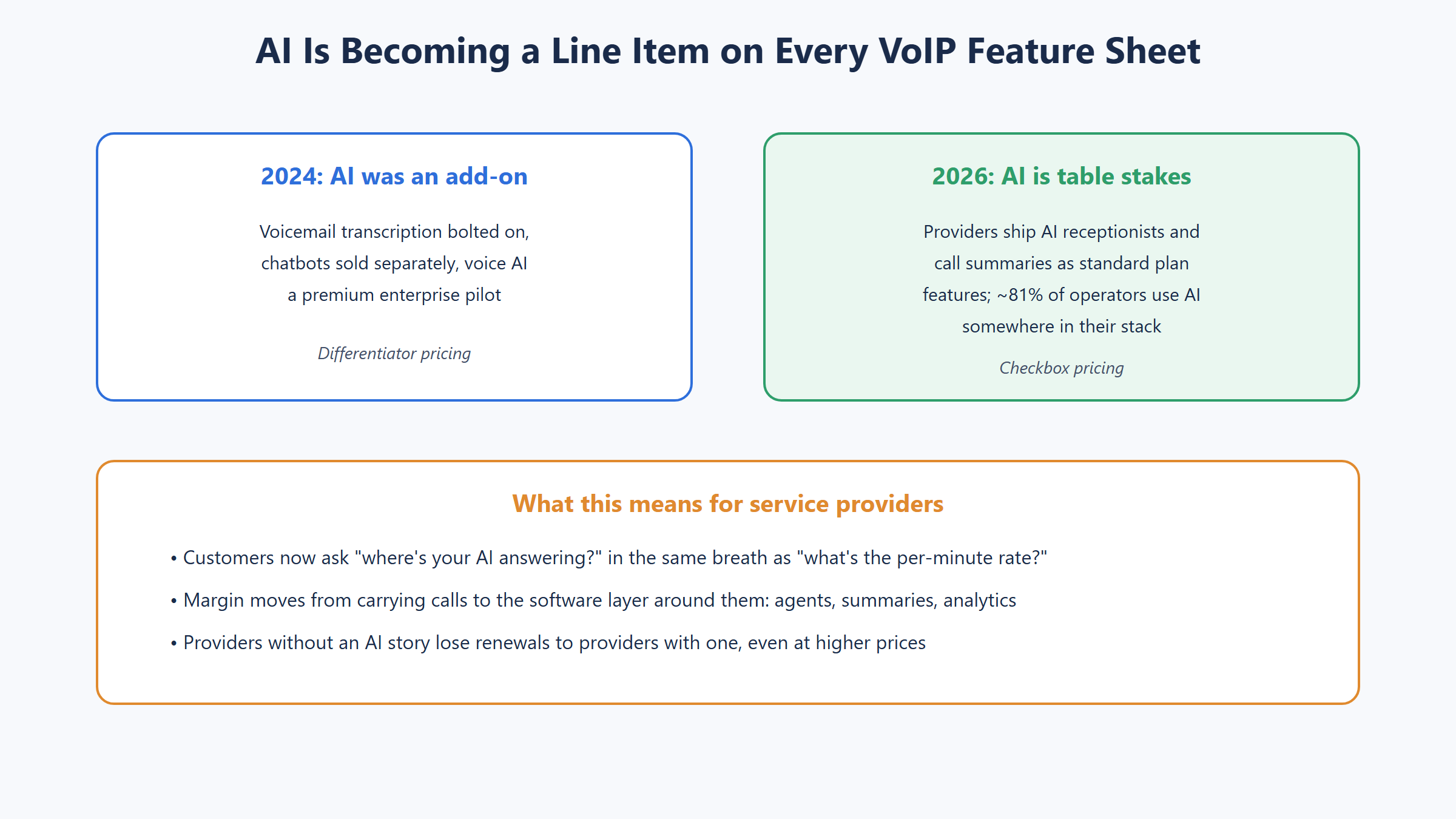
Something shifted in VoIP product pages this month, and it’s easy to miss because it looks like marketing noise. Residential and business VoIP providers started listing AI answering, the virtual receptionist that takes a call, answers questions, and books the appointment, as a standard plan feature. Not an enterprise pilot, not a paid add-on. A checkbox next to voicemail. Surveys back the shift up: roughly 81% of telecom operators now use AI somewhere in their stack. For service providers, the question stopped being whether to have an AI story and became which layer of your stack it lives in.
Why the Checkbox Matters More Than the Feature
When a capability moves from premium add-on to default expectation, the economics around it flip. Customers stop paying extra for it and start penalizing its absence. That’s where AI answering is heading in VoIP: renewal conversations now include “where’s your AI receptionist?” in the same breath as per-minute rates and trunk capacity.
For the operators and resellers we work with, this lands on top of an older squeeze. Carrying calls has been commodity margin for a decade; the money migrated to the software wrapped around the calls: PBX features, campaign tools, analytics, portals. AI is simply the newest floor of that building, and it’s being added fast enough that providers without it lose deals to providers with it, even at higher prices.
The Stack Answer: Own What Lasts, Swap What Churns
Here’s the trap in responding to this with a vendor contract: the AI layer is the least stable layer in the whole stack. Models get cheaper and better quarterly. The speech-to-text engine that was state of the art in January is mid-pack by June. Weld your service to one vendor’s AI and you’ve bolted the fastest-changing component to the slowest-changing contract.
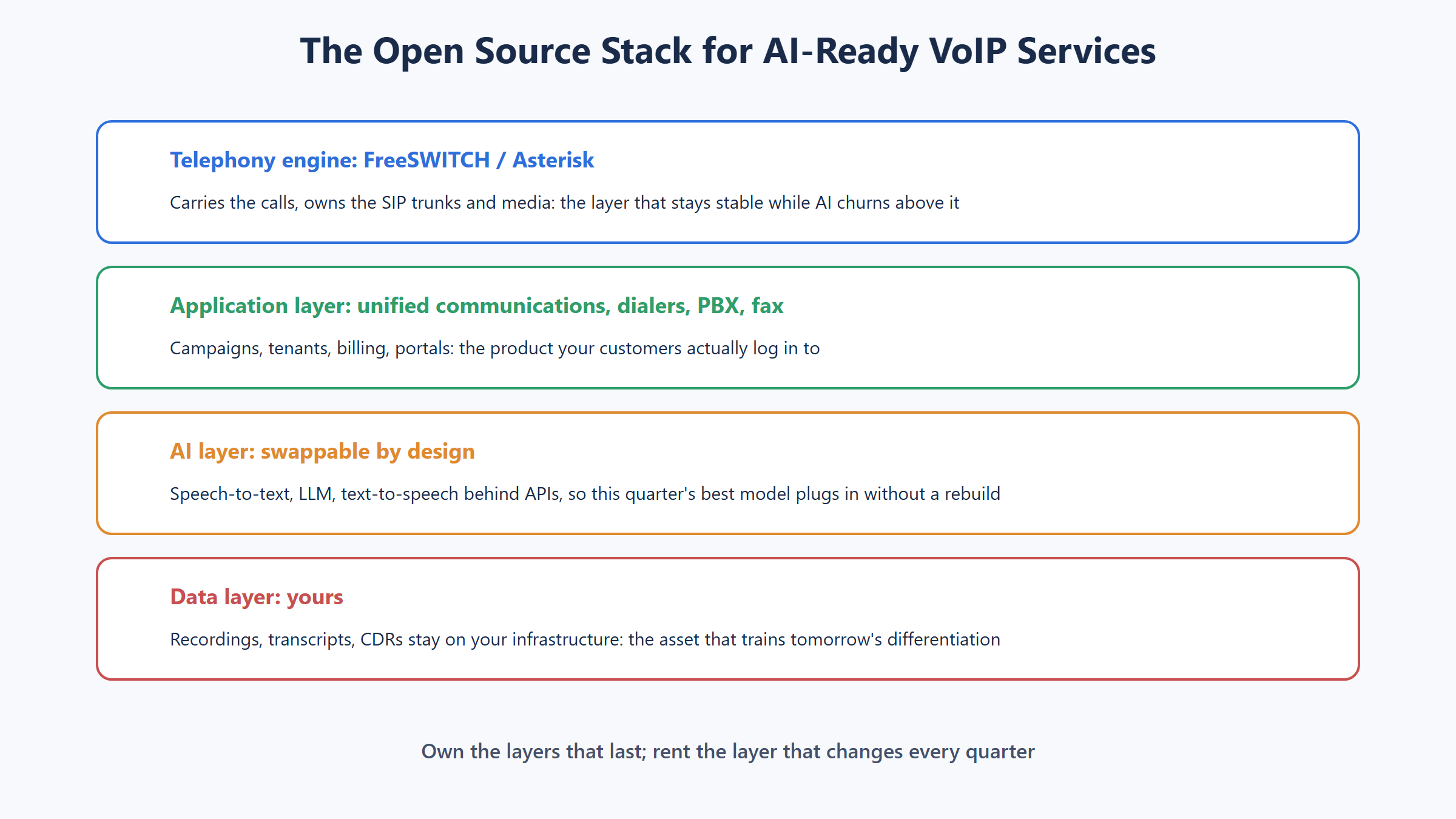
The structure that works looks like this. At the bottom, an open source telephony engine, FreeSWITCH or Asterisk, owns the SIP trunks and media. This layer barely changes year to year, which is exactly why you want to own it. We’ve compared the options in our analysis of open source SIP servers if you’re choosing now.
Above it, the application layer: the unified communications platform, dialer, PBX, or fax service your customers log into. This is your product and your billing relationship. Open source options here are mature, our roundup of open source VoIP software covers the field, and ICT Innovations builds its product line (ICTBroadcast, ICTDialer, ICTFax, ICTPBX) on exactly this pattern.
Then the AI layer, and this is the one to keep swappable by design. Speech-to-text, the language model, text-to-speech, each behind an API boundary so that switching providers is a configuration change. The providers shipping AI receptionists as checkbox features are mostly doing it this way internally; the mistake would be building your version any other way.
Underneath everything sits the layer people forget until it’s gone: the data. Recordings, transcripts, call detail records. Keep them on your own infrastructure and every future AI improvement can be tuned on your actual traffic. Hand them to a platform vendor and you’ve given away the asset that would have differentiated you. That, more than license fees, is the strongest argument for the open source route here.
What to Do This Quarter
If you’re a service provider, three moves cover most of the ground. Audit your plans against the new baseline: if competitors in your market list AI answering as standard and you don’t, that gap is costing renewals now. Pick your API boundaries: decide where speech, language, and voice synthesis plug into your stack, and write the integration so the vendor name is a config value. And start logging with AI in mind: transcripts and outcomes captured cleanly today are the tuning data for whatever you deploy next year.
The checkbox era of VoIP AI rewards the boring virtues: owning your telephony, keeping your data, and staying free to chase the best model each quarter. Open source has been the right answer to the first two for twenty years. It turns out to be the right answer to the third one too.
FAQ
Is AI answering really standard on VoIP plans now?
Increasingly, yes. Multiple providers rolled AI receptionist features into standard business and even residential plans this year, and industry surveys put AI adoption at roughly 81% of telecom operators. It’s following the same path voicemail transcription took: premium first, checkbox next.
What does an AI receptionist actually do?
It answers inbound calls, handles routine questions like hours and directions, books or reschedules appointments, takes structured messages, and routes callers to humans when the request falls outside its scope. All of it runs on the same SIP infrastructure as ordinary calls.
Why keep the AI layer swappable?
Because it changes faster than any other layer. Model pricing and quality shift quarterly, so an API boundary that makes switching providers a configuration change protects you from paying last year’s premium for last year’s model.
Can open source VoIP platforms support AI features?
Yes. Open source engines like FreeSWITCH and Asterisk handle the call media, and AI services connect through standard APIs for speech recognition, language processing, and synthesis. The open platform approach is what keeps each piece replaceable.
What data should service providers keep for AI?
Call recordings (where consent allows), transcripts, call detail records, and outcome labels like resolved or escalated. Stored on your own infrastructure, this becomes the tuning and evaluation data for every future AI feature you ship.