
If you run FreeSWITCH and can’t move to 1.11.3 this week, you can still close CVE-2026-116779 today. Set enable-chat=false on every SIP profile, stop directory users with no password from authenticating, and restart the profiles. Then check it worked, because the SIP response code alone won’t tell you.
That’s the short version. The longer one matters because this bug is in CISA’s Known Exploited Vulnerabilities catalog, the fix landed in a release a lot of open source VoIP shops can’t install yet, and several of the “hardening” steps being passed around don’t touch the actual route. Here’s a checklist you can work through on your own boxes, with the commands.
What happened, and why the dates look odd
CVE-2026-116779 lets one SIP MESSAGE run FreeSWITCH API commands. The CVSS score is 9.8. SignalWire’s advisory, GHSA-mg63-h38w-8p9p, says plainly that exploitation “has been observed in the wild”.
The timeline confuses people, so here it is in order:
- 14 July 2026: a public GitHub issue on signalwire/freeswitch (#3078) describes MESSAGE routing into the
apichat path. It’s still open. - 28 August: FreeSWITCH 1.11.3 ships with a new
enable-chat-api-protosetting. The release notes mention it in one line, without a CVE. - 28 October: the advisory goes public.
- 5 November: NVD publishes the CVE.
- 9 November: CISA adds it to the KEV catalog, with a federal due date of 12 November.
- 18 November: 1.11.4 ships, and it’s now the current release.
So the fix existed for two months before most admins had a reason to look for it. If you only track CVE feeds, you heard about it in November, with three days to act.
How one MESSAGE becomes an API call
When mod_sofia gets an inbound MESSAGE, sofia_presence_handle_sip_i_message() looks at the user part of the To header. If there’s a plus sign in it, the left half is taken as a chat protocol name. mod_dptools registers a chat protocol called api, and it hands whatever follows to switch_api_execute(). Where mod_lua is loaded, as it is in stock config, inline Lua is a second way in.
Three defaults make this worse than it sounds. Chat is on unless a profile turns it off, and the vanilla internal and external profiles don’t. MESSAGE authentication has been on by default since 1.10.7, but any account on the profile passes it. And a directory user with neither a password nor an a1-hash param authenticates with any password at all, unless allow-empty-password is false. Vanilla ships two such users: default and the Skinny example.
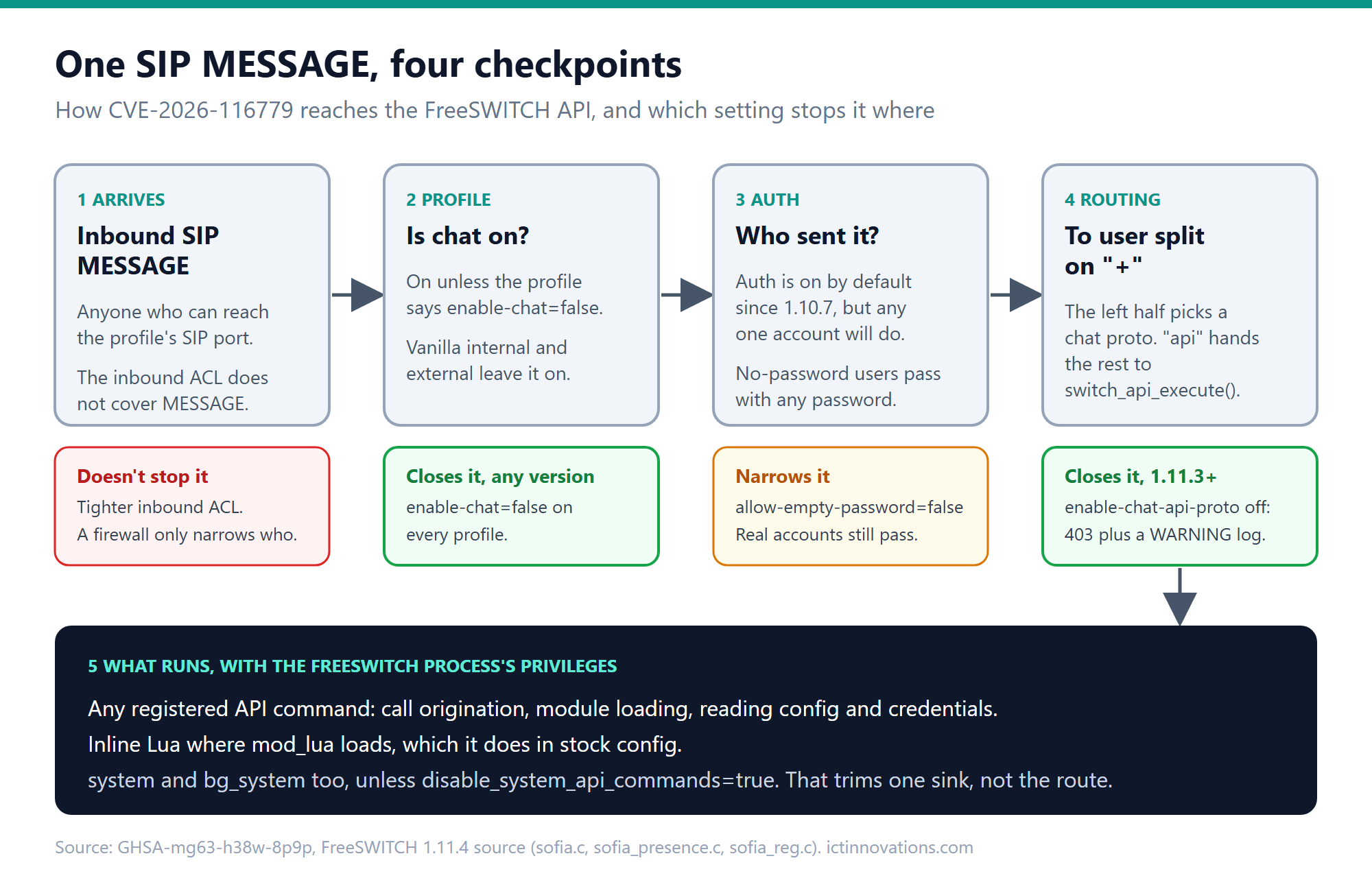
Notice the first box. The inbound ACL doesn’t apply to MESSAGE, so a tight apply-inbound-acl leaves you exactly as exposed as before. A firewall helps only in the sense that it shrinks the list of people who can try.
Step 1: find out if you’re exposed
Start with the version and the profiles that are actually running. Anything at 1.11.2 or below is affected, and that includes every 1.10.x build.
fs_cli -x "version"
fs_cli -x "sofia status"
fs_cli -x "sofia xmlstatus profile internal" | grep -E "sip-ip|ext-sip-ip|bind-url"
Run the last line for each profile sofia status lists. A profile bound to a public address, or with an ext-sip-ip, is your first priority. Don’t skip the IPv6 profiles if they’re loaded.
Next, find profiles that don’t explicitly switch chat off. Package installs keep config in /etc/freeswitch; source builds usually use /usr/local/freeswitch/conf.
cd /etc/freeswitch/sip_profiles
grep -L 'name="enable-chat" value="false"' *.xml
Every file this prints has chat on. A missing line means “on”, not “off”, which is why a quick grep for enable-chat that comes back empty is bad news rather than good.
Then look for directory users with no password and no hash:
grep -rl '<user ' /etc/freeswitch/directory | xargs grep -L -E 'name="(password|a1-hash)"'This one is rough, since a file can define several users, but it catches the common cases. It deliberately doesn’t count vm-password as a password, and that’s the trap worth calling out. Some provisioning scripts and control panels create voicemail-only users that carry a vm-password and no SIP password. To mod_sofia, those are passwordless users, so they open the same door as the vanilla default user. If your directory comes from a database through mod_xml_curl or a Lua handler, run the equivalent query against the source table instead.
Step 2: close it without the upgrade
Here’s the part that matters if your repo stops short of 1.11.3. Plenty do: the Fedora Copr build for EL8 tops out at 1.10.12, and other community repos stop at 1.11.1. SignalWire’s advisory lists no fixed 1.10.x release. Configuration is what you’ve got.
In every SIP profile, inside <settings>:
<param name="enable-chat" value="false"/>In the directory, at the domain level so every user inherits it:
<domain name="$${domain}">
  <params>
    <param name="allow-empty-password" value="false"/>
    ...
  </params>
We checked how this inherits rather than assuming. FreeSWITCH merges domain and group params into each user at lookup, and a value set on the user wins. So one line at the domain closes passwordless authentication for everyone, unless some user explicitly sets it back to true. Voicemail keeps working, because mailbox logins use vm-password, not SIP digest auth. While you’re in there, rename default.xml and skinny-example.xml in directory/default to something that doesn’t end in .xml, and get rid of the 1000 to 1019 demo users if they still carry the stock 1234 password.
As defence in depth, add this to vars.xml:
<X-PRE-PROCESS cmd="set" data="disable_system_api_commands=true"/>It stops mod_commands from registering system, bg_system, spawn and bg_spawn. It doesn’t close the route. Call origination and module loading are still reachable through it, so treat it as a seatbelt, not a fix. It’s read when mod_commands loads, which means it only takes effect after a full FreeSWITCH restart.
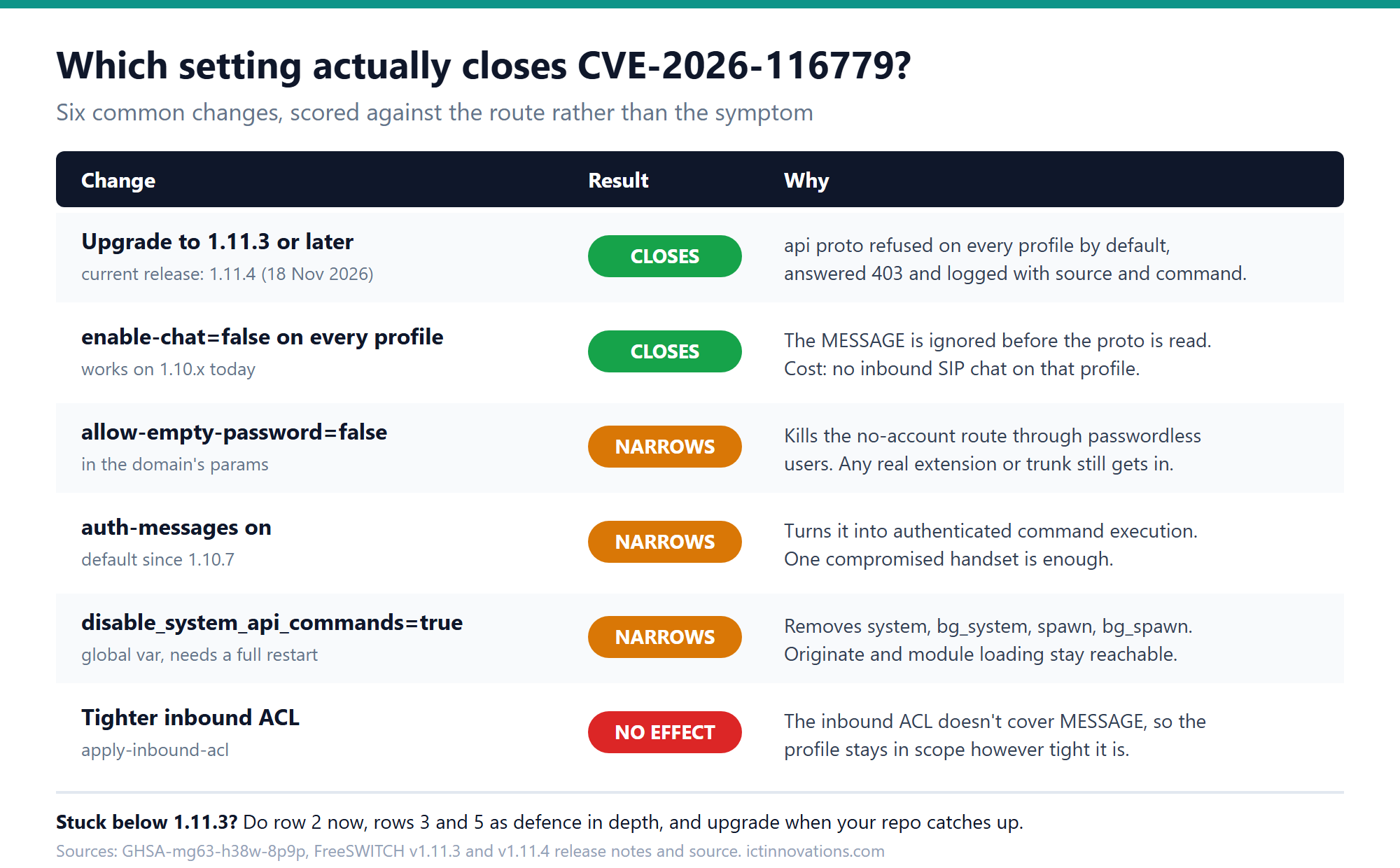
If a control panel generates your profile and directory XML, make these changes in the panel. Edit the files by hand and the next save will put chat back on.
Step 3: apply it, and mind the restart
fs_cli -x "reloadxml"
fs_cli -x "sofia profile internal restart"
fs_cli -x "sofia profile external restart"
Reloadxml picks up the directory change. The profile restarts pick up enable-chat. A profile restart drops every call on that profile, so do it in a quiet window.
There’s a catch we’d want to know about before typing that at 2am. An open FreeSWITCH issue, #3285, filed on 16 November, shows sofia profile restart hanging for good on a box with voicemail, where the profile’s domain isn’t an alias. The profile never comes back and phones on it have no service until FreeSWITCH itself restarts. Since disable_system_api_commands needs a full restart anyway, a planned restart of the whole service is the cleaner move on most single-box PBXs.
Step 4: check that it actually worked
Don’t judge this by the response code. With chat off, FreeSWITCH still answers a MESSAGE with 202 Accepted (or 200 if you’ve set it to); it just doesn’t process it. A closed profile and an open one can look identical from the sender’s side.
Test delivery instead, and only on a server you own. Register two softphones to two extensions on the profile and send a plain text message from one to the other. You can drive the sending side with sipsak or a similar tool if you’d rather script it. If the message arrives, chat is still on. If it doesn’t, the profile is ignoring inbound MESSAGE, which is what you want. Repeat for each profile. There’s no need to send anything that names a chat protocol to prove the point, and we’d advise against it on production.
On 1.11.3 or later you get a better signal. A MESSAGE that tries the api protocol on a profile where it isn’t enabled is answered 403, and FreeSWITCH logs a WARNING naming the profile, the source address and the requested command. Alert on that line. It’s free attack telemetry.
On older builds, look backwards too. Search your SIP captures or siptrace logs for inbound MESSAGE requests whose To user starts with api followed by a plus sign. If you find any from outside, assume the box was used. Rotate the credentials its config holds (SIP gateways, ESL password, database), and review loaded modules, dialplan and cron for anything you didn’t put there.
What we changed in our open source projects
We ship FreeSWITCH inside several open source VoIP projects, so we made the same changes there on 25 and 26 November. All of it is public on github.com/ictinnovations:
- ICTCore sets
enable-chat=falsein its ownictcore.xmlprofile. The Docker image build now fails if any loaded profile still has chat on, and the Ubuntu installer turns chat off and removes the passwordless and password-1234 vanilla demo users. - ICTFax and ICTDialer Docker images run the same build step. The images on Docker Hub and GHCR were rebuilt on 25 November.
- ICTPBX Community Edition turns chat off on every profile, sets
allow-empty-password=falseper tenant domain and setsdisable_system_api_commands=true. Re-running the installer fixes an existing server.
The build-time check is the piece we’d suggest copying. A config fix that lives only on one server gets lost at the next rebuild; a build that refuses to produce an image with chat on doesn’t forget. If you run ICTPBX specifically, the ICTPBX write-up covers that product’s side. For background on the Community Edition itself, see the ICTPBX Community Edition release notes.
Where this leaves open source VoIP teams
Honestly, the config workaround is good enough to sleep on. With chat off on every profile, the vulnerable handler returns before it reads the To header. Upgrading is still the right end state, because 1.11.3 closes the route by default on profiles you forget about. It also covers mod_verto, which got the same enable-chat-api-proto setting in that release.
If this feels familiar, it should. Our triage of the earlier FreeSWITCH CVE batch made the same argument: work out where the bug lives before you decide what to patch. The SIP DoS hardening guide covers the firewall and rate-limit side, which still matters here for shrinking who can reach a profile at all.
FAQ
Will enable-chat=false break presence, BLF or message waiting lights?
No. In the mod_sofia source, that flag is only checked in the inbound MESSAGE handler. Presence and BLF ride on SUBSCRIBE and NOTIFY, and MWI notifications go out the same way, so they keep working. What you lose is SIP text chat between phones on that profile.
My SIP port only accepts traffic from my phones and my trunk. Am I safe?
You’re less exposed, not safe. Any device you allow through can still send the MESSAGE, and auth only needs one valid account. A single compromised handset or a leaked extension password is enough, so turn chat off anyway.
Is there a patched 1.10.x release?
Not according to the advisory, which lists fixed versions as 1.11.3 and later. If your package source only carries 1.10.12, the config change is your fix until you can move to a repo or a source build that ships 1.11.3 or 1.11.4.
Does allow-empty-password=false stop voicemail logins?
It shouldn’t. Mailbox access checks vm-password in mod_voicemail, while allow-empty-password applies to SIP digest authentication. Test one mailbox after the change to be sure on your own build.
How do I know if someone has already used this on my server?
Search SIP captures and logs for inbound MESSAGE requests with a To user starting with api and a plus sign. On 1.11.3 or later, watch for the WARNING log line about a rejected api chat proto. Any hit from an outside address should be handled as an incident, with credential rotation and a review of modules, dialplan and scheduled jobs.
Do I need to worry about mod_verto too?
The advisory describes the SIP path. Still, 1.11.3 added the same enable-chat-api-proto gate to mod_verto, so if you run verto, that’s one more reason to upgrade. If you don’t use it, unloading it shrinks your attack surface, as our earlier triage post explains.